




Your recommendation is the strongest predictor of patients getting vaccinated1

How to personalize your SHINGRIX recommendation to your patients 50 years and older

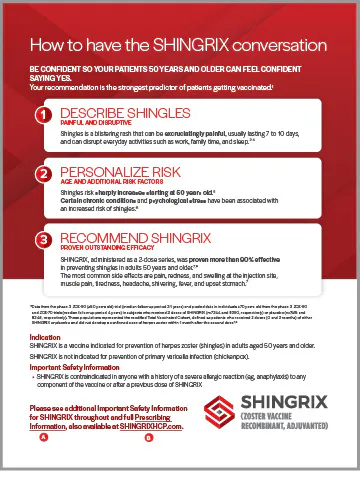
DESCRIBE SHINGLES

PAINFUL AND DISRUPTIVE

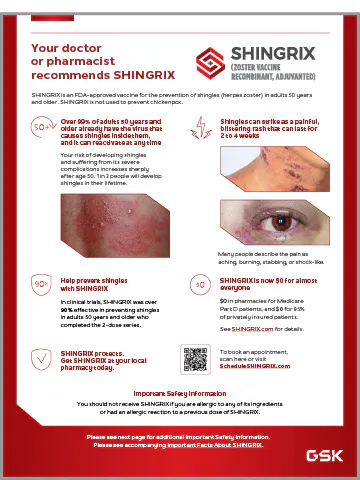
Shingles is a blistering rash that can be excruciatingly painful, usually lasting 7 to 10 days, and could disrupt everyday activities such as work, family time, and sleep.2-4

PERSONALIZE RISK

AGE AND ADDITIONAL RISK FACTORS

Starting at age 50, the risk of shingles sharply increases.5 In addition to age, certain chronic conditions as well as psychological stress have been associated with an increased risk of shingles.6,*

RECOMMEND SHINGRIX

PROVEN OUSTANDING EFFICACY

SHINGRIX, administered as a 2-dose series, was proven more than 90% effective in preventing shingles in people 50 years and older.7,†

The most common side effects are pain, redness, and swelling at the injection site, muscle pain, tiredness, headache, shivering, fever, and upset stomach.7

  • *

    Risk factors for shingles were assessed as part of a meta-analysis. The methodology used to define psychological stress varied greatly across studies and included patient questionnaires and major life events (either self-reported or captured on medical record, eg, death of a spouse or diagnosis of major medical event).6

  • Data from the phase 3 ZOE-50 (≥50 years old) trial (median follow-up period 3.1 years) and pooled data in individuals ≥70 years old from the phase 3 ZOE-50 and ZOE-70 trials (median follow-up period 4 years) in subjects who received 2 doses of SHINGRIX (n=7344 and 8250, respectively) or placebo (n=7415 and 8346, respectively). These populations represented the modified Total Vaccinated Cohort, defined as patients who received 2 doses (0 and 2 months) of either SHINGRIX or placebo and did not develop a confirmed case of herpes zoster within 1 month after the second dose.7,8

Looking for information to address questions your patients might ask?

HOW TO DISCUSS SHINGLES PROTECTION WITH YOUR PATIENTS ≥50 YEARS OLD

ABOUT SHINGLES

Explain to your patients that shingles can strike without warning and could disrupt their everyday activities such as work, family time, and sleep2,3

Your patients can develop shingles any time of year, so don’t wait to discuss the risks and how SHINGRIX can help protect your appropriate patients.2,7,9

Patient portrayal.

Questions a patient might ask you

What is shingles?

Shingles is a painful blistering rash that can last for weeks and is caused by the reactivation of the varicella zoster virus (the same virus that causes chickenpox). The pain during shingles could make it difficult to go to work, sleep, or spend time with family.2-4

What is the risk of developing shingles?

About 1 in 3 people will get shingles in their lifetime, and an estimated 1 million cases occur each year in the US. The risk of developing shingles sharply increases after age 50.5

If I feel healthy, do I need to worry about getting shingles?

Shingles is caused by the reactivation of the varicella zoster virus, the same virus that causes chickenpox.2 Inform your patients that if they are one of the 99% of adults over the age of 50 who have had chickenpox, the virus that causes shingles is already inside their body and it can reactivate at any time. Even if your patients feel healthy, their immune systems weaken as they age, increasing their risk of developing shingles.2,5,10


Let them know that 1 in 3 people will develop shingles in their lifetime.5

Personalized Recommendation Guide PDF image

Personalized Recommendation Guide

This guide provides 3 important talking points to share with your appropriate patients.

Download

MAKE IT PERSONAL

Emphasize the urgency to your patients and make their risk personal

Review the risk and potential impact of shingles, and explain how SHINGRIX can help protect them against shingles.

Patient portrayal.

Questions a patient might ask you

What can increase my risk of getting shingles?

Age is one of the most important risk factors for shingles.2 A person’s risk of developing shingles sharply increases after age 50.5 In addition to age, people 50 years and older may have other factors associated with an increased risk of shingles, including diabetes, cardiovascular conditions, chronic kidney disease, and psychological stress.6

Are there long-term or serious complications from shingles?

Yes. One complication of shingles is postherpetic neuralgia (PHN), which can cause severe pain that lasts for months or even years in the area of the healed rash. If shingles occurs in or around the eye, it can lead to ocular complications and, in rare cases, vision loss.2,11


SHINGRIX is not indicated for the prevention of PHN or other herpes zoster-related complications.7

Who is SHINGRIX indicated for?

SHINGRIX is indicated for prevention of shingles in adults aged 50 years and older.7


To get the full protection offered by SHINGRIX, it is important to complete the 2-dose series.7

What to Expect Pamphlet PDF image

What to Expect Pamphlet

This pamphlet contains information your patients should know when receiving SHINGRIX.

DOWNLOAD

CHOOSE SHINGRIX

RECOMMEND SHINGRIX TODAY TO HELP PREVENT SHINGLES IN THE FUTURE

SHINGRIX, administered as a 2-dose series, was proven to help prevent shingles in adults 50 years and older.7 When patients receive a vaccine recommendation and are offered the vaccine at the same time, they are more likely to get vaccinated.1

Actor portrayals.

Questions a patient might ask you

How effective is SHINGRIX?

SHINGRIX demonstrated outstanding efficacy. In clinical trials, SHINGRIX was proven to be more than 90% effective in preventing shingles in adults 50 years and older who completed the 2-dose series.7,‡


The most common side effects of SHINGRIX are pain, redness, and swelling at the injection site, muscle pain, tiredness, headache, shivering, fever, and upset stomach.7


Data from the phase 3 ZOE-50 (≥50 years of age) trial (median follow-up period 3.1 years) and pooled data in individuals ≥70 years old from the phase 3 ZOE-50 and ZOE-70 trials (median follow-up period 4 years) in subjects who received 2 doses of SHINGRIX (n=7344 and 8250, respectively) or placebo (n=7415 and 8346, respectively). These populations represented the modified Total Vaccinated Cohort, defined as patients who received 2 doses (0 and 2 months) of either SHINGRIX or placebo and did not develop a confirmed case of herpes zoster within 1 month after the second dose.7,8

How much does SHINGRIX cost?

SHINGRIX costs $0 for most patients ≥50 years old with commercial insurance or Medicare Part D.12,13


Get real-time information about formulary coverage for SHINGRIX in your area.


Cost and coverage may vary and are subject to change. Reimbursement decisions are made by individual insurance plans.

Can SHINGRIX be given with other vaccines?

According to the CDC, recombinant and adjuvanted vaccines (like SHINGRIX) can be administered concomitantly with other adult vaccines, including a flu vaccine.14


The Prescribing Information for SHINGRIX contains information regarding the concomitant administration of SHINGRIX with flu, pneumococcal, and Tdap vaccines.7


Data are limited regarding the coadministration of SHINGRIX with other vaccines.

CDC=Centers for Disease Control and Prevention; Tdap=tetanus, diphtheria, and acellular pertussis.

SHINGRIX is administered as a 2-dose series with the second dose given 2 to 6 months after the first.7

Help your patients complete the 2-dose series

Encourage them to book their second appointment at your office or a pharmacy by visiting

Indication & Important Safety Info

Indication

Important Safety Information

Indication

SHINGRIX is a vaccine indicated for prevention of herpes zoster (HZ) (shingles):

  • in adults aged 50 years and older.
  • in adults aged 18 years and older who are or will be at increased risk of HZ due to immunodeficiency or immunosuppression caused by known disease or therapy.

SHINGRIX is not indicated for prevention of primary varicella infection (chickenpox).

Important Safety Information

  • SHINGRIX is contraindicated in anyone with a history of a severe allergic reaction (eg, anaphylaxis) to any component of the vaccine or after a previous dose of SHINGRIX
  • Review immunization history for possible vaccine sensitivity and previous vaccination-related adverse reactions. Appropriate medical treatment and supervision must be available to manage possible anaphylactic reactions following administration of SHINGRIX
  • In postmarketing observational studies, an increased risk of Guillain-Barré syndrome has been observed during the 42 days following vaccination with SHINGRIX
  • Syncope (fainting) can be associated with the administration of injectable vaccines, including SHINGRIX. Procedures should be in place to avoid falling injury and to restore cerebral perfusion following syncope
  • Solicited local adverse reactions reported in individuals aged 50 years and older were pain (78%), redness (38%), and swelling (26%)
  • Solicited general adverse reactions reported in individuals aged 50 years and older were myalgia (45%), fatigue (45%), headache (38%), shivering (27%), fever (21%), and gastrointestinal symptoms (17%)  
  • Solicited local adverse reactions reported in autologous hematopoietic stem cell transplant recipients (aged 18 to 49 and ≥50 years of age) were pain (88% and 83%), redness (30% and 35%), and swelling (21% and 18%)  
  • Solicited general adverse reactions reported in autologous hematopoietic stem cell transplant recipients (aged 18 to 49 and ≥50 years of age) were fatigue (64% and 54%), myalgia (58% and 52%), headache (44% and 30%), gastrointestinal symptoms (21% and 28%), shivering (31% and 25%), and fever (28% and 18%)
  • The data are insufficient to establish if there is vaccine-associated risk with SHINGRIX in pregnant women
  • It is not known whether SHINGRIX is excreted in human milk. Data are not available to assess the effects of SHINGRIX on the breastfed infant or on milk production/excretion
  • Vaccination with SHINGRIX may not result in protection of all vaccine recipients


Please see full Prescribing Information.

To report SUSPECTED ADVERSE REACTIONS, contact GSK at gsk.public.reportum.com or
1-888-825-5249, or VAERS at 1-800-822-7967 or www.vaers.hhs.gov.

References

  1. Adult immunization standards. Centers for Disease Control and Prevention. Reviewed August 9, 2024. Accessed July 6, 2026. https://www.cdc.gov/vaccines-adults/hcp/imz-standards/index.html

  2. Harpaz R, Ortega-Sanchez IR, Seward JF; Advisory Committee on Immunization Practices (ACIP) Centers for Disease Control and Prevention (CDC). Prevention of herpes zoster: recommendations of the Advisory Committee on Immunization Practices (ACIP). MMWR Recomm Rep. 2008;57(RR-5):1-30.

  3. Curran D, Matthews S, Boutry C, Lecrenier N, Cunningham AL, Schmader K. Natural history of herpes zoster in the placebo groups of three randomized phase III clinical trials. Infect Dis Ther. 2022;11(6):2265-2277.

  4. Shingles symptoms and complications. Centers for Disease Control and Prevention. Reviewed April 19, 2024. Accessed July 6, 2026. https://www.cdc.gov/shingles/signs-symptoms/index.html

  5. Clinical overview of shingles (herpes zoster). Centers for Disease Control and Prevention. Reviewed June 27, 2024. Accessed July 6, 2026. https://www.cdc.gov/shingles/hcp/clinical-overview/index.html

  6. Marra F, Parhar K, Huang B, Vadlamudi N. Risk factors for herpes zoster infection: a meta-analysis. Open Forum Infect Dis. 2020;7(1):1-8.

  7. Prescribing Information for SHINGRIX.

  8. Data on file. Study 113077 (NCT01165229). GSK Study Register. Study entry at: https://www.gsk-studyregister.com/en/trial-details/?id=113077

  9. Berlinberg EJ, Kim E, Deiner MS, Patterson C, Porco TC, Acharya NR. Seasonality of herpes zoster and herpes zoster ophthalmicus. J Clin Virol. 2020;126:104306.

  10. Kilgore PE, Kruszon-Moran D, Seward JF, et al. Varicella in Americans from NHANES III: implications for control through routine immunization. J Med Virol. 2003;70(suppl 1):S111-S118.

  11. Clinical features of shingles (herpes zoster). Centers for Disease Control and Prevention. Reviewed May 10, 2024. Accessed July 6, 2026. https://www.cdc.gov/shingles/hcp/clinical-signs/index.html

  12. Data on file, GSK.

  13. Wreschnig LA. Selected Health Provisions of the Inflation Reduction Act. Congressional Research Service. 2022;1-3. Accessed July 6, 2026. https://crsreports.congress.gov/product/pdf/IF/IF12203

  14. Shingles vaccine recommendations. Centers for Disease Control and Prevention. Reviewed October 22, 2024. Accessed July 6, 2026. https://www.cdc.gov/shingles/hcp/vaccine-considerations/index.html

    Questions About SHINGRIX?

    Call: 1-800-772-9292

    Available Monday - Friday

    8:30 am to 5:30 pm ET